
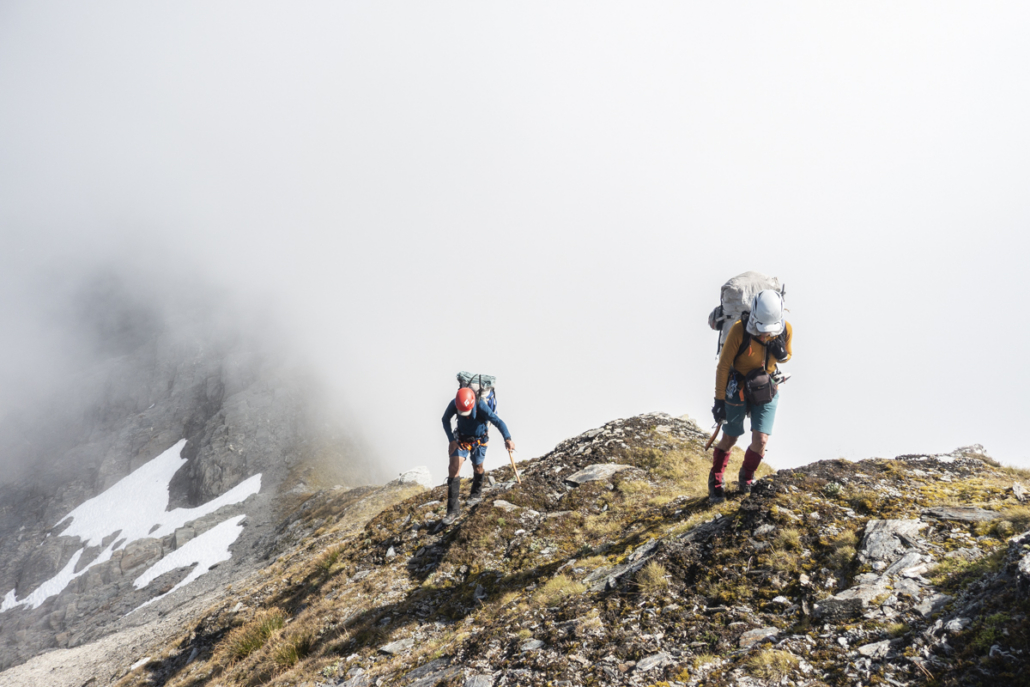
Some practical considerations for timing your guided journey in the Southern Alps.
This article is written to help you decide when might be the best time for a trip in New Zealand’s mountains. (Spoiler – There is no ‘best time’ – it depends on your specific trip objectives.)
Daylight hours
For a roughly two month period around the winter solstice (21 June), you’ve only got about nine hours of usable daylight, or about eight hours in the deep south like Fiordland. This is great if you’re here for astro-photography (the best region of the Milky Way is visible during the southern winter) but a little challenging otherwise.
For December and most of January, it’s light from about 5:30 in the morning until about 9:30 in the evening, so there’s more than enough time for relaxing at camp after an active day. March (autumn) and September (spring) provide 12-13 hours of daylight, much like the rest of the world.
Precipitation
There is no such thing as a rainy season or dry season in Aotearoa. Everyone has their own generalisations, like “La Niña brings fine weather in November”; “It’s usually dry on the west coast during midwinter”; “There’s less precipitation in autumn”; “There’s more rain in spring”; “Always wait until mid-Spring for the biggest dump of snow”… Unfortunately there are notable exceptions to all of these, and none of them can be relied on. Rain can sometimes last more than five days in a row, then after you’ve had one clear day it rains again for another five days; conversely you could have three weeks of almost perfect weather. Plan for everything.
It’s unusual for all of the Southern Alps / Ka Tiritiri o te Moana to receive bad weather simultaneously for more than a day or two. This means that if you’re willing to do some driving, you can usually find a trip location with some good weather no matter what the weather is doing.
Temperatures
The main rule is that in any given week, at any time of year, temperatures can fluctuate wildly and you need to be prepared for a huge range of conditions.
January and February are typically the warmest months, when it can be over 25 degrees C on a fine day even above the bushline. However, rain and wind combined with single digit temperatures can still occur. Evenings and nights are usually cool, and if a southerly is blowing a warm sleeping bag is welcome for high campsites. Down below the bushline a lightweight sleeping bag is adequate, especially if you’re staying in huts. For a month or so either side of those months (i.e. December and March) things aren’t too much cooler.
Mid-April is usually when you notice things starting to really cool down. May is distinctly colder again but fine days can still be comfortable wearing one layer in the afternoon. Winter (June to August) is simply cold: it’s possible to have days that never get above freezing. Temperatures slowly but steadily increase from September to December with no major thresholds.
Snowfall and Snow Cover
You may be tired of hearing “it’s variable” but nowhere is that more relevant than when discussing snow. Above the bushline, summer snowfalls are not common but do rarely occur. In general if you’re below 2000m, it’s unusual to have any significant snowfall before mid April. Thick dustings of snow do occur during late April and May, often down to the bushline and creating a lovely visual texture on the mountains, but these usually melt away within a week or so. June is known as a cursed month in the snowsports world – monster snowfalls raise optimism about the ski season ahead, but this is often followed by weeks of warm or dry conditions. By the time more snow arrives, practically nothing is left and we’re starting from scratch again.
Continual snow cover above mid altitudes (around 1500m) is usually pretty reliable from mid-July through until late September – that date range is the most reliable for skiing and snowboarding. Large areas of snow – enough for adventurous ski touring – can stick around longer, sometimes until early December, especially in gullies and on south-facing slopes. Higher areas (above 1800m) can even hold significant snow through January. February, March, and early April have the least amount of snow in the hills. On glaciers, crevasses become more and more exposed as summer progresses. Things are usually pretty “filled” in December and very broken by late March. In summary: if you’d like a warm trip but also some fun in the snow, December and early January are the best.
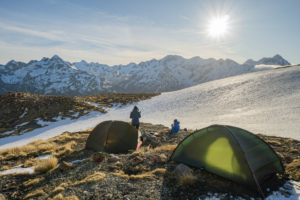
A snowline camp near Arthurs Pass in late October.
River Levels
If your trip involves crossing rivers, you’re probably already aware that rainfall will have a significant impact on them. Most rivers will need a day or two to return to “normal” flows after a storm has passed. Those “normal” flows fluctuate significantly from season to season. Snow on the ground plus warm temperatures equals lots of melting, therefore rivers are generally at their highest during spring. Crossings can be difficult or impossible even if it hasn’t rained in days, and spring storms can result in monster river flows due to both heavy rain and rapid snow melting. Conversely, most rivers experience their lowest flows from late autumn to mid-winter, as much of the precipitation is falling as snow which isn’t melting quickly.
In summary there will generally be the biggest range of trip options available during late summer and autumn since the rivers are less of an obstacle then.
Lambing
If you need access through private farmland, be aware that a lot of animals are being born from mid/late winter to late spring/early summer. Many tracks are closed during this time – find out in advance so you don’t get an unpleasant surprise at the start of your trip.



Leave a Reply
Want to join the discussion?Feel free to contribute!