Tips and Tricks
Advice on techniques, clothing, equipment, food, navigation, and other pearls of wisdom.

Advice on techniques, clothing, equipment, food, navigation, and other pearls of wisdom.
Spare layers, repair kits, and more… Our chief guide Rob goes through the items that should be packed for any trip in the hills, whether you’re tramping, hunting, ski touring, or mountaineering. Chances are you won’t need it, but there are times when this equipment could be life-saving.
Often people only think of a first aid kit, but really there are several other items that should be considered non-negotiable, even for just a day trip.
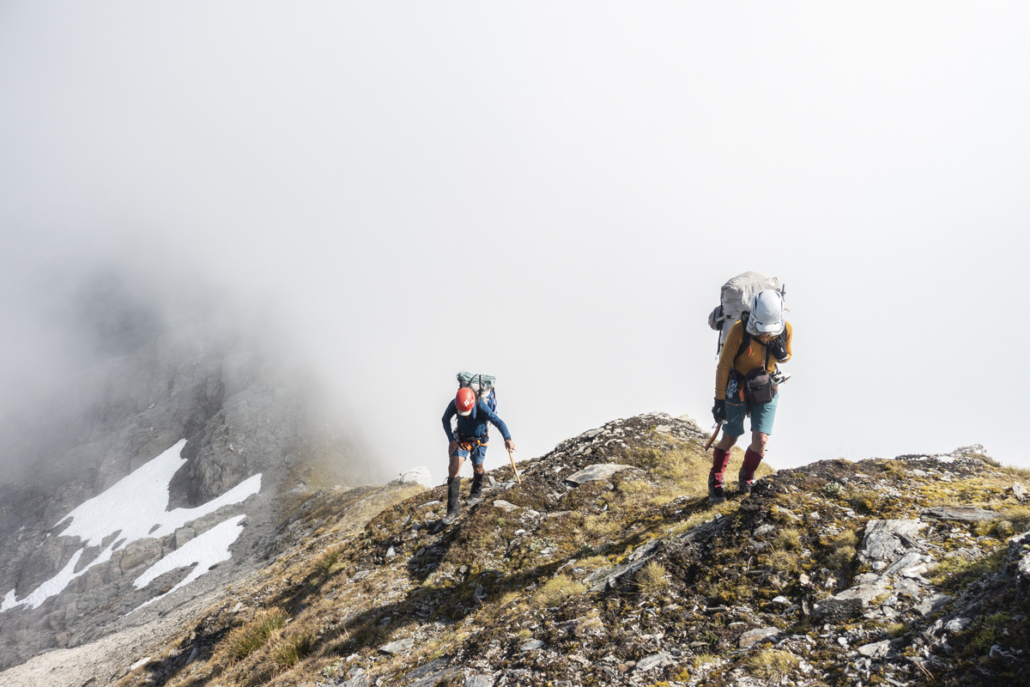
This article is written to help you decide when might be the best time for a trip in New Zealand’s mountains. (Spoiler – There is no ‘best time’ – it depends on your specific trip objectives.)
Daylight hours
For a roughly two month period around the winter solstice (21 June), you’ve only got about nine hours of usable daylight, or about eight hours in the deep south like Fiordland. This is great if you’re here for astro-photography (the best region of the Milky Way is visible during the southern winter) but a little challenging otherwise.
Keep ReadingFor December and most of January, it’s light from about 5:30 in the morning until about 9:30 in the evening, so there’s more than enough time for relaxing at camp after an active day. March (autumn) and September (spring) provide 12-13 hours of daylight, much like the rest of the world.
Precipitation
There is no such thing as a rainy season or dry season in Aotearoa. Everyone has their own generalisations, like “La Niña brings fine weather in November”; “It’s usually dry on the west coast during midwinter”; “There’s less precipitation in autumn”; “There’s more rain in spring”; “Always wait until mid-Spring for the biggest dump of snow”… Unfortunately there are notable exceptions to all of these, and none of them can be relied on. Rain can sometimes last more than five days in a row, then after you’ve had one clear day it rains again for another five days; conversely you could have three weeks of almost perfect weather. Plan for everything.
It’s unusual for all of the Southern Alps / Ka Tiritiri o te Moana to receive bad weather simultaneously for more than a day or two. This means that if you’re willing to do some driving, you can usually find a trip location with some good weather no matter what the weather is doing.
Temperatures
The main rule is that in any given week, at any time of year, temperatures can fluctuate wildly and you need to be prepared for a huge range of conditions.
January and February are typically the warmest months, when it can be over 25 degrees C on a fine day even above the bushline. However, rain and wind combined with single digit temperatures can still occur. Evenings and nights are usually cool, and if a southerly is blowing a warm sleeping bag is welcome for high campsites. Down below the bushline a lightweight sleeping bag is adequate, especially if you’re staying in huts. For a month or so either side of those months (i.e. December and March) things aren’t too much cooler.
Mid-April is usually when you notice things starting to really cool down. May is distinctly colder again but fine days can still be comfortable wearing one layer in the afternoon. Winter (June to August) is simply cold: it’s possible to have days that never get above freezing. Temperatures slowly but steadily increase from September to December with no major thresholds.
Snowfall and Snow Cover
You may be tired of hearing “it’s variable” but nowhere is that more relevant than when discussing snow. Above the bushline, summer snowfalls are not common but do rarely occur. In general if you’re below 2000m, it’s unusual to have any significant snowfall before mid April. Thick dustings of snow do occur during late April and May, often down to the bushline and creating a lovely visual texture on the mountains, but these usually melt away within a week or so. June is known as a cursed month in the snowsports world – monster snowfalls raise optimism about the ski season ahead, but this is often followed by weeks of warm or dry conditions. By the time more snow arrives, practically nothing is left and we’re starting from scratch again.
Continual snow cover above mid altitudes (around 1500m) is usually pretty reliable from mid-July through until late September – that date range is the most reliable for skiing and snowboarding. Large areas of snow – enough for adventurous ski touring – can stick around longer, sometimes until early December, especially in gullies and on south-facing slopes. Higher areas (above 1800m) can even hold significant snow through January. February, March, and early April have the least amount of snow in the hills. On glaciers, crevasses become more and more exposed as summer progresses. Things are usually pretty “filled” in December and very broken by late March. In summary: if you’d like a warm trip but also some fun in the snow, December and early January are the best.
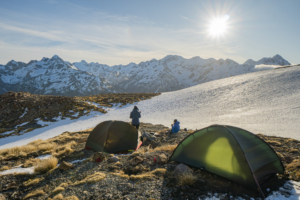
A snowline camp near Arthurs Pass in late October.
River Levels
If your trip involves crossing rivers, you’re probably already aware that rainfall will have a significant impact on them. Most rivers will need a day or two to return to “normal” flows after a storm has passed. Those “normal” flows fluctuate significantly from season to season. Snow on the ground plus warm temperatures equals lots of melting, therefore rivers are generally at their highest during spring. Crossings can be difficult or impossible even if it hasn’t rained in days, and spring storms can result in monster river flows due to both heavy rain and rapid snow melting. Conversely, most rivers experience their lowest flows from late autumn to mid-winter, as much of the precipitation is falling as snow which isn’t melting quickly.
In summary there will generally be the biggest range of trip options available during late summer and autumn since the rivers are less of an obstacle then.
Lambing
If you need access through private farmland, be aware that a lot of animals are being born from mid/late winter to late spring/early summer. Many tracks are closed during this time – find out in advance so you don’t get an unpleasant surprise at the start of your trip.
As someone who leads trips across the full spectrum of New Zealand terrain, from easy family-friendly day trips to climbs up Aoraki, I’ve had a fair amount of experience working out exactly what type of waterproof over-trousers (aka ‘overtrou’) different conditions actually need.
by Rob Frost
Keep ReadingThe one you’ll use 90% of the time
Unless you’re specifically planning technical alpine work, a pair of lightweight overtrou – such as the first two options in the list below – is all you need. They’ll block the wind, keep you dry in most conditions, and add almost nothing to your pack weight.
The five options compared
Option 1: Ultralight emergency (~140 g)
Best for trips where the forecast is good and you just want a safety net. The Montane Minimus is a typical example. The short zip means you’ll need to remove your boots to put them on, but this is just a minor trade-off for the incredible packability.
Option 2: Lightweight packable (~160 g)
The step-up from ultralight. A knee-length zip and wider cut means you can pull them on and off over your boots. The Macpac Nazomi and Marmot Precip are good examples. Not built for bush-bashing or snow travel, but ideal for most days on the trail.
Option 3: Mid-weight durable (~375 g)
My personal favourite. Tough enough to last through repeated use, with a zip that goes roughly two-thirds up your leg. Enough to get on and off over crampons if you’re careful. No full-length zip means the waist stays slim and your hip belt doesn’t push them down. Earth Sea Sky have made this style in the past (the ‘Traverse’) and we’re trying to convince them to bring it back!
Option 4: Full-zip durable (~500 g)
The example in the video is Earth Sea Sky’s Vent-X Extreme. Same tough fabric as Option 3, but with a full-length zip. These are very easy to get on and off over boots, crampons, skis, or simply when conditions are bad enough that you don’t want to faff around. The trade-off however is a bulkier waist closure that can ride down under a heavy hip belt.
Option 5: Bibs / salopettes (650-800g)
Straps over the shoulders mean full torso coverage, so no cold gaps when you lean forward or reach up. These types of overtrou are essential for cold mountaineering, snow skills instruction, avalanche rescue practice, and digging snow caves. The tidy cut also sits neatly outside gaiters without excess fabric near your crampons.
An honourable mention! Softshell trousers
In cold, dry winter conditions when any precipitation will fall as dry snow rather than rain, softshell trousers can actually outperform a hard shell. They provide a comfortable base layer which is also windproof. You can layer overtrou on top if the weather turns wet, or thermal leggings underneath when it’s really cold. For multi-day winter trips, this combination is genuinely versatile.
Inside or outside your gaiters?
This generates more debate than it deserves. The logic is straightforward: if it’s raining and you want to keep water out of your boots, over trousers belong on the outside of your gaiters. Water runs down the outside of your trousers and over the gaiter, not into your boot.
If your trousers are well-fitted and your crampon technique is solid, the snagging risk is minimal. If your trousers are baggy, or you simply want them tidy and contained while front-pointing, then you should tuck them inside your gaiters.
Another star appearance in Mountain Journeys trip cuisine is our South Indian Dhal. This recipe was picked up on Rob’s travels through Kerala…
by Rob Frost
Keep ReadingCook it in a big batch and dehydrate overnight, then freeze in individual portions that can be packed at short notice for your next trip in the hills!
Tasty, nutritious and filling – this meal is also vegan and gluten free. It can also be customised depending on how spicy you like it!
Practically every tramping or hiking gear list mentions “gaiters” but there are so many different types out there – how do you choose the right ones? And do you really need them at all?
by Rob Frost
Keep ReadingWHY USE GAITERS?
Primarily, gaiters keep stuff out of your boot. In most cases we’re talking about scree/loose rocks and snow. If your gaiter has a really snug fit on your boot and you’re quick, they’ll often keep most of the water out for a shallow stream crossing, too.
Gaiters have a few useful secondary functions: they can stop both mud and clingy vegetation like hook grass and biddy bids from sticking to your socks, laces, and boot uppers; they can constrain baggy trousers when it’s a safety issue (if you’re wearing crampons and you don’t want them to snag); and they can protect your lower legs from scratchy vegetation and from wind in poor weather.
If none of the above are an issue on your trip, or you only have very brief sections of loose rock or snow, you don’t need gaiters. I’d argue that you can get away just fine without gaiters on New Zealand’s popular tracks. For more rugged trails, and certainly for off-track tramping or mountaineering, gaiters will be a friend. A good friend if you follow this advice…
SIZE
Traditional advice tells you to fit the gaiter to your boot size. While this seems logical, you could end up with a gaiter that’s too floppy or too tight on your calves. Tight gaiters are uncomfortable; floppy gaiters snag and/or fall down.
So, fit the gaiter according to the size of your calf. Even a small gaiter (for skinny legs) can still fit over the top of a big boot. Just make sure the strap underneath is long enough, since the gaiter may sit higher than intended.
SNOW
If you’re intending to use your gaiters to help you deal with snow, there are a few important requirements to look for. Snow is really good at forcing its way inside your gaiter if you don’t have a very firm fit. Make sure the gaiter sits smoothly and cleanly against your boot; it should be difficult to get more than a couple of fingertips under the lower edge of the gaiter.
You must use the underfoot strap to stop the gaiter being forced up by the snow.
Crampons should have minimal things they can catch on mid-stride, so your gaiters should have no bunched fabric (no elastic halfway up) and no long cord dangling from the top.
Velcro closures at the front of your gaiters are a handy place to stow away excessively long crampon straps, too.
STRAPS
Make sure the strap is replaceable – I’ve been forced to stop using otherwise excellent gaiters simply because of poor strap design with no option for replacement.
I tend to avoid the third party steel cable straps because they fray as they wear out, resulting in lots of sharp loose cable ends. If you do go for those, avoid the key-ring style attachments, they’re a joke. By the end of their first trip they will have snagged and become stretched and misshapen.
If you’re using your own cord, go for 3mm or 4mm spectra/dyneema cord, available from boating shops.
NO SNOW
If you’re not travelling in snow, an underfoot strap is nice to help hold the gaiter’s shape, but it isn’t essential. You can get away without a strap if (a) you’ve got high ankle boots; and (b) a low-fitting gaiter; and (c) you’re not travelling in snow. In that case, the lace hook should be all you need to keep the gaiter in position.
TROUSERS IN OR OUT?
If your priority is to keep water out of your boots during rain, then keep your waterproof trousers on the outside. If your priority is to protect the bottom of your trousers from scuffs, or to keep any trousers constrained so that your crampons don’t snag, then tuck them inside your gaiters.
HIGH vs LOW
If you don’t need to keep baggy trousers contained when using crampons, and you don’t need protection from scratchy vegetation, then short gaiters (aka puttees) can be excellent. The trick is to also have a really good seal at the top, because it’s more likely that stones or snow could overtop a short gaiter. Such a fit is hard to achieve without stretchy fabric, and stretchy fabric usually isn’t as durable.
FAVOURITES
My favourite gaiters I’ve ever owned were a pair made by OR which I bought in 2010. They were a low height, and a slightly stretchy, fairly tough fabric. When I was in Nepal I found a local tailor to take them in at the top so that they fit snugly around my skinny legs. After that they kept out everything, including leeches! A year later, one of the straps finally detached at one end, and that was that. I’ve been seeking something similar ever since, but to no avail. Hopefully I’ll find the perfect gaiter before I retire!

It might seem odd. If you’re not going on a climbing, mountaineering, canyoning, or caving trip, then why would you take a helmet?
by Rob Frost
Keep ReadingI know people who’ve been airlifted out of the hills on a tramping trip because they’ve been following a river for hours and hours on slippery boulders. They’ve fallen over and hit their head against a rock and unfortunately sustained a head injury. It happens easily.
Many adventurous tramping trips involve other types of sustained rocky terrain, or confined scree gullies with rockfall. Just because you’re “only tramping”, it doesn’t mean you shouldn’t consider a helmet.
So, I highly encourage you to take one of these if you’re considering such a trip. Many helmets out there weigh so little that you practically forget that you’re wearing one. I particularly like the Petzl Sirocco but there are similar helmets by other brands, too. Try different brands to see which one suits the shape of your head best.
Please don’t misconstrue this advice as though I’m advocating wearing helmets all the time. Chucking them on everywhere just to be “safe” leads you into the trap of not properly considering where areas of heightened risk really are.
Make sure that you carry your helmet inside your pack if you’re not wearing it. Attaching it to the outside is just asking for it to be damaged.

Even day trips can put you in serious positions, so we like to ensure we carry the essentials.
Here’s a gear list that you can use as a prompt next time you’re heading out.
Want a good day pack to put it all in? Check out the Kea in our shop, made lovingly in Christchurch by Twin Needle.

This is a meal which always gets rave reviews from participants on our trips. It’s easy to cook in one big pot, and dehydrates easily.
Here’s a PDF you can download for easy printing, or feel free to check out the recipe here:
Keep ReadingINGREDIENTS (makes enough for a 4-person meal)
4 Tbsp Vegetable Oil (Coconut recommended)
1-2 tsp Cumin Seeds
1⁄2-1 tsp Fennel Seeds
3 flat mushrooms (cut into small chunks)
1 medium-large orange Kumara (peeled & grated)
2 medium Carrots (peeled and grated)
1 Cauliflower (chopped into bite size pieces)
2 tsp Salt
2 1⁄2 Tbsp Tamarind Paste
1 Tbsp Crushed Ginger
1⁄2 tsp Black Pepper (fine)
1⁄2 tsp Cardamom powder
1⁄2 tsp Sumac
1 bag Baby Spinach
OPTIONAL:
1 tsp Onion or Garlic Powder
Chili (powder, or fresh, add with
mushrooms)
TO ADD AFTER DEHYDRATING:
70g sliced Almonds
75-100g Coconut milk powder
DIRECTIONS:
FIELD PREPARATION
To rehydrate, add to enough boiling water such that the mixture is still quite runny after 5 minutes of absorption (have some extra boiling water on standby). Simmer for 5-10 minutes then cover and sit for another 10 minutes. Serve with brown rice. If you want to be fancy, serve with parsley garnish and/or some toasted almonds!

There has been much discussion about this issue, and rightfully so – more people than ever are getting into the outdoors, and if human waste isn’t properly considered then we’ll end up with contaminated water and an unsightly, smelly mess at your next campsite.
Unfortunately there’s also been a lot of half-baked information from otherwise reputable sources about what to do when there isn’t a toilet available. As in, what if you can’t dig a hole and you won’t go past a long drop toilet on your way out? What should you do with your… deposit? Here’s our summary.
by Rob Frost
Keep ReadingQ1: Can I bury it?
It’s always easier to bury your poo than to carry it, but to bury it the site must meet these three requirements:
If you meet all three of those criteria, your answer to Q1 is YES. Dig a small hole 10-20cm deep, keeping the surface matter separate from the deeper soil. Do your business, then when backfilling make sure the surface matter goes back on top.
If you don’t meet all three of the above criteria, then your answer to Q1 is NO, and you’ll need to carry your poo for at least a short while, perhaps the rest of the trip. The following questions will help work out how.
Q2: Will I go past a long drop toilet later in my trip?
(The type that doesn’t involve the contents being flown and sucked out for transfer to a treatment station?)
If your answer to Q2 is YES, then you can poo into a compostable bag, eg cornstarch, then later in your trip simply plop it into the long drop. This doesn’t work for barrel toilets, as they’re emptied regularly and the bags break down very slowly, so will probably clog up the pumps.
If your answer to Q2 is NO, you still might not need to carry your package all the way to the road…
Q3: Will I go past any place later in my trip where I could leave my poo?
(E.g. a barrel toilet or somewhere with organic soil suitable for burial.)
If your answer to Q3 is YES, then you can poo into any bag (small to medium bin bags are good – they don’t need to be biodegradable). Later in the trip, empty the contents of your bag into a suitable hole in the soil or into a barrel toilet. You’ll still need to carry out the dirty rubbish bag, but at least it won’t weigh much anymore! I like to use a ziploc completely reinforced with duct tape as my carry bag for soiled bags. (That ziploc is also for any used toilet paper, which shouldn’t be buried – it should only go into designated toilets or in the rubbish.)
If your answer to all three questions is NO, NO, and NO, then you’ll need to carry your poo all the way out and dispose of it in the rubbish. Disposing of human waste into the rubbish is an offence unless you treat it with a product like Poo Powder, which has deodorising and gelling agents. (There are a few similar products out there.) I’ll sometimes “pre-load” some rubbish bags with poo powder before a trip if I know I’ll need to do this, e.g. an alpine trip with no toilets.
How to carry the goods
For any of the above carry-out options, it’s a good idea to double-bag your goods, as well as having either a tough drybag or reliable rigid container to contain everything, like the homemade PVC tube container pictured here. Even the most airtight container can still smell a little, so it’s best to carry these – carefully – on the outside of your pack.

Snow camping is a magical experience in the right conditions, but needs careful planning to be enjoyable. It doesn’t involve just taking your standard tent to the snow, pitching it normally, and simply taking more warm gear to deal with the cold.
by Rob Frost
Keep ReadingSite Selection
First you’ll need to choose a site which is safe from avalanches, not too exposed to the wind, and is reasonably flat.
Earthworks
Winds can be strong up in the snow, so you’ll need to dig out your camp site before pitching your tent and/or make some snow walls around your tent after pitching it. Having a snow shovel is essential for both of these. Once your tent is pitched, digging down further in the vestibule improves your storage space and your ease of entry/exit.
Anchoring
You’ll need to figure out how to anchor your tent as you can’t use standard pegs. Fabric snow/sand anchors, large aluminium snow-specific pegs, or buried snow-filled stuff sacks with cord around them all work well. Don’t plan to use your ice axes, shovels, and walking poles as anchors – it renders them unavailable for anything else.
Tent Selection
A proper four-season tent not only deals with strong winds, it’s also easier to seal up to prevent windblown snow getting inside and reduce draughts. The fly should go to ground level (no gap along the bottom edge) and you should be able to cover up all mesh panels on the inner tent. (Some ventilation is still important, but it should be controlled by you, not by unavoidable excessive airflow in a lightweight tent.)
Toileting
If you’re in a group you’ll need to consider where you’ll position your “latrine” – a large hole in the snow where people can get some privacy to use their poo bags (you’re not leaving it up there).
Stoves
Many stoves are unsuitable for using directly on the snow, but placing your stove on a small thin piece of plywood (20x30cm) works a charm. Bring a small bowl in which to place your gas canister in warm water – it makes it perform way better in the cold.

Tramping in winter and spring requires quite a few extra or different items compared to the warmer months. We’ve developed a gear list that you can use as a prompt next time you’re preparing for a trip – check it out here, and please let us know if you have any feedback. We’ve tried to include some succinct advice on a few items, instead of purely making it a tick list.

There are a ton of things you can do to reduce how much weight you carry, but I think these four things will make the biggest difference.
by Rob Frost
Keep ReadingStop using that old sleeping bag.
Still using your uncle’s 30 year old Fairydown Everest? A new sleeping bag will save you a ton of weight and space, and can still be just as warm. (By the way, it’s not just your sleeping bag that keeps you warm at night; a full belly, an effective mattress, avoiding draughts, and going to bed warm all help. If you’re cold after dinner, go for a short walk to get the blood flowing.)
Get a lightweight pack.
Some canvas packs, especially those with lots of extra pockets, compartments, and attachments, can be up to 3 kg completely empty, and will absorb a load of water when it’s raining. Look out for something around 1.5kg if you can.
Don’t carry too much water.
Consider where you can fill up with fresh water, either from streams or huts. Our Chief Guide Rob usually only uses a 500mL bottle, but carries a flexible 1.5L bottle for those sections of the trip where he’s going to be away from water for a long time. Use electrolyte tablets to ensure you get the most out of what you drink.
Less spare clothes.
Use merino sparingly – it takes ages to dry and doesn’t keep you as warm in damp conditions. For the same amount of warmth, synthetic layers weigh so much less than merino and dry out quickly, thus requiring less backups. Take an extra base layer for freshness if you’ll be on a trip 4 days or longer.

By Rob Frost, with information from Dr Robin Barraclough
While hypothermia is a year-round risk in New Zealand, now that we’re approaching winter this risk is even more acute, especially if wet/windy weather or river crossings are involved. Here are the two most effective things you can do for someone who’s starting to get dangerously cold:
Methods that are not so great for heating someone up: external heat sources (like a fireplace, or getting into a sleeping bag with them) or getting them to walk faster. The key points are to stop further heat loss, and give their body the energy source to generate internal heat.

We’ve developed a gear list that you can use as a prompt next time you’re preparing for a trip – check it out here, and please let us know if you have any feedback.
This list doesn’t include prompts for any gear for snow travel – which is still possible above the bushline in early summer.

Rob’s devoted a full page on this website to an article about boots for transalpine tramping and hunting trips where snow is a major component. Such trips may also feature scree and rock scrambling, steep tussock, and rugged untracked river valleys – as well as boots for mountaineering, generally up to grade 2.
Most of the boots here are warm enough for winter instruction courses, but you may have slightly cold feet some of the time when you’re not moving around.
Click Here to check out the article.

Our chief guide Rob had the pleasure of featuring in Wilderness Magazine’s “What’s In My Pack?” Unfortunately they were a little pushed for space, so not all of the text he sent was included.
So, here’s the full version! This is for a typical summer transalpine trip. If you’d like any further details on any of the items mentioned here, please let us know!
Keep ReadingJust a short outline on what I think are the best brands, before I get into the detail: I get almost all of my clothing from Earth Sea Sky, sleeping bags from One Planet, and packs from Twin Needle (all of which are available through the Mountain Journeys online shop). I get most of everything else from Further Faster. I love Salewa boots and primarily use them, but also have a few pairs of La Sportiva.
Also included in my regular kit – with no sponsorship – are Hilleberg tents (far and away the best tents for transalpine trips in Aotearoa), Grivel crampons and ice axes, Ortovox avalanche equipment, and MSR stoves.
———
Pack:
Twin Needle ‘Tuke’ (60L, expandable by 10L) – a lightweight (1.4kg) yet tough and modular pack with all the right attachments. I’ve used it for trips up to seven days long. I use the detachable hipbelt pockets for snacks and a small drink bottle. For trips where I need to take a LOT of stuff, I really like my 75L Black Diamond Mission.
Alpine Equipment:
Grivel Air Tech Evo ice axe, Grivel Air Tech Light aluminium crampons, Petzl Sirocco helmet (so light you forget you’re wearing it), and Hilleberg walking pole. If the trip involves glacier travel or some tricky steps I’ll also bring an Edelrid Loopo Lite harness, a lightweight rope (40m Edelrid Rap Line) and associated rescue equipment – probably the topic of another post sometime!
Tent:
All of my tents are made by Hilleberg as I need really dependable shelter. I’ll usually use a Niak or Akto for myself, but if I’m sharing with 1-2 others I often use an Anjan 3 – it sleeps 3 people, can hold up to very strong winds, but weighs only 2.0kg.
Dry Bag 1:
For things that don’t need to be accessed during the day. Sleeping bag (One Planet Cocoon -8 or Nitrous -3 depending on the forecast), mattress (ThermaRest NeoAir XLite – the clear winner for me), lightweight shoes (Astral Loyak) or crocs, camp clothes (Earth Sea Sky Mercury Leggings, merino t-shirt, and socks), and toiletries/notebook/powerbank.
Stove+Pot:
MSR Windburner Duo (1.8L) works well for 2-3 people. With bigger groups I’ll use the 2.5L and/or 4.5L pots and sometimes a second Windburner.
Useful Tricks:
These items make the difference in subtle but effective ways for me.
-Suunto Core watch – super basic but it’s tough, has an altimeter and thermometer, and the battery lasts for months. It’s securely attached to my shoulder strap so it’s always visible but out of the way.
-Aarn Shoulder Strap Pocket to hold my InReach Mini, hand sanitiser, sunscreen, and lip balm.
-I’ve also started using an E9 Kangaroo bumbag for map, compass, phone,
-Small piece of closed cell foam for sitting/kneeling.
-Gill Championship sailing gloves for tough subalpine scrub and rock scrambling.
Boots:
I’ve discovered the perfect boots for most of my trips: the Salewa Ortles LT Mid. They’re stiff enough for cramponing, flexible enough for valley walking, have good edges for secure sidling on steep slopes, and are really light. For trips where I need slightly more stiffness, I like the Salewa Crow.
Clothes:
Almost all of my clothing is from Earth Sea Sky (ESS). It’s long-lasting, comfortable, very practical, and made in NZ. I use their Rock Star trousers for protection from sun, wind, and scrub, either the Silk Weight Sun Hoodie or Power Wool Zip Polo as my base layer, and the Stealth pullover as a lightweight second layer.
Dry Bag 2:
For extra clothing that I might need during the day:
-A buff, beanie, and sunhat
-Gloves: Montane Prism gloves for cold trips, or some rubber-palmed work gloves from a hardware shop for other trips
-For a warm layer, I’ll take one of the following: ESS Helium II, ESS Alpha, or Montane Fortes Lite synthetic jacket depending on how I’m feeling at the start of the trip!
Waterproofs:
ESS Zeal Guide jacket and either the Montane Minimus trousers or the ESS Vent-X Overtrou.
Food:
Most of my meals are ones that I’ve cooked and dehydrated myself at home (in this picture it’s a yellow split pea dhal). I love Bushline instant breakfasts by YUM Granola, and also enjoy Firepot (especially the Orzo Bolognese), Real Meals, and the occasional Radix dinner. For snacks, Torq bars are great, and I always bring chocolate. For a savoury change: tamari almonds and wasabi peas!
Dry Bag 3:
The random things you often need in a hurry: repair kit, a headlamp with spare batteries, and toilet paper.
Extras:
-First aid kit (when guiding this is quite extensive) which I keep in specialised dry bags, camera (usually a Sony A6500 with 10-18mm and 55mm lenses), drink bottles, electrolyte tablets, bowl, mug, spoon, and sunglasses.